What this table is measuring, and what it is not
Most comparison pages here are ranked lists wearing a table’s clothes. Someone decides an order, writes a sentence of praise for each entry, and the columns exist to make the opinion look like arithmetic. We have a ranked list too. It lives on the rankings page and it’s openly a judgement call.
This page is a different thing. Every cell in the table above is a fact the platform published about itself, copied down on a single day, with the source linked. Where we formed an opinion, it’s in the score column and nowhere else. Where a platform published nothing, the cell says so instead of filling in a plausible number.
That last decision changed the page. We set out to compare nine prices and ended up with five, because four of these companies don’t tell a logged-out visitor what they cost. That isn’t a gap in the research. It’s the finding.
The four platforms that will not quote you a price
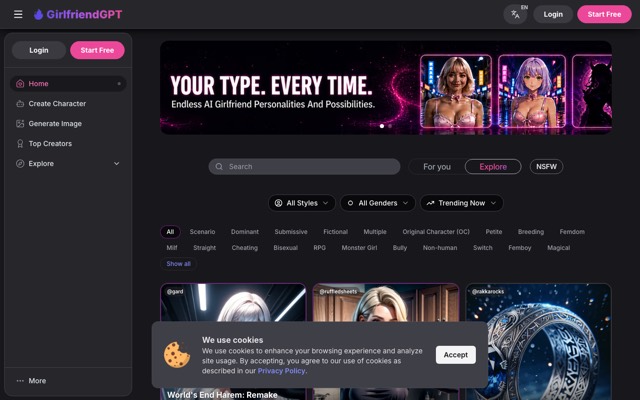
SpicyChat, Nomi, Replika and GirlfriendGPT all sell subscriptions. None of them will show you the price before you’ve created an account or installed an app.
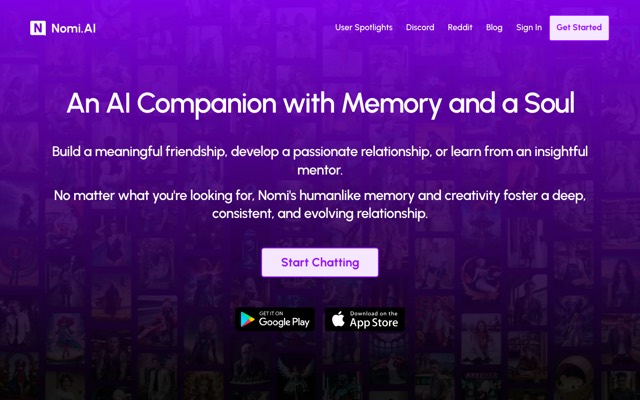
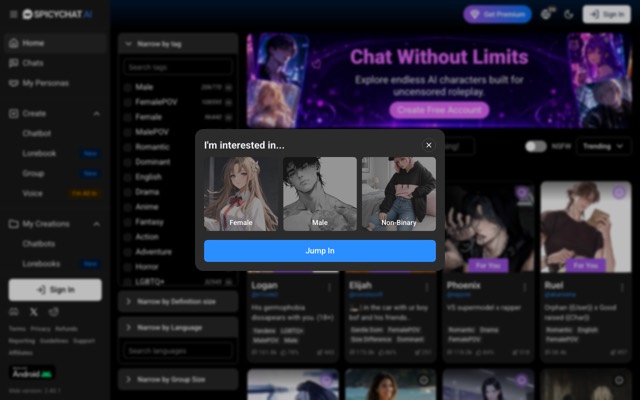
The specifics differ. SpicyChat’s pricing page returns a 404, and the Get Premium button in its header opens a loading spinner that never resolves for a signed-out visitor. Nomi has no pricing page at all. Not a broken one, not a gated one. The only claim its marketing site makes about money is that it’s free to start chatting. GirlfriendGPT’s pricing page renders its navigation, its product copy and its footer, but no prices.
Replika is the most straightforward about it. Its own help centre states that the cost “is shown in the app on the subscription screens and in the relevant store,” which is a polite way of saying you’ll find out after you’ve downloaded something.
None of this is illegal or even unusual in software. Plenty of enterprise tools hide pricing behind a sales call. But this isn’t enterprise software. These are consumer subscriptions bought by individuals, often quietly, frequently on a phone, and the normal practice is that you commit to an install and an account before anyone tells you the number.
The practical advice is narrow but real. If you’re comparing options, those four can’t be compared on price until you’ve signed up for them. Budget for that friction. It’s deliberate.
What “free” means, nine different ways
Every platform here has something it calls a free tier. They aren’t the same kind of object, and the differences are large enough that the word means very little without a number attached.
At one end, Character.AI’s free tier is a genuinely usable product. You get unlimited messages on its basic models, with advertising and a slow mode when the service is busy. You could use it indefinitely and never pay. The $9.99 subscription buys speed, better models, memory and the removal of ads. Not access.
Kindroid takes a similar shape with harder edges: unlimited messages, but on “Lite,” which it describes as a smaller distilled version of the flagship model. Alongside that, one selfie request every two hours up to a maximum of two, five thousand lifetime audio characters (roughly five minutes of speech, ever) and two companions. It’s a real product with a visible ceiling, and it tells you where the ceiling is.
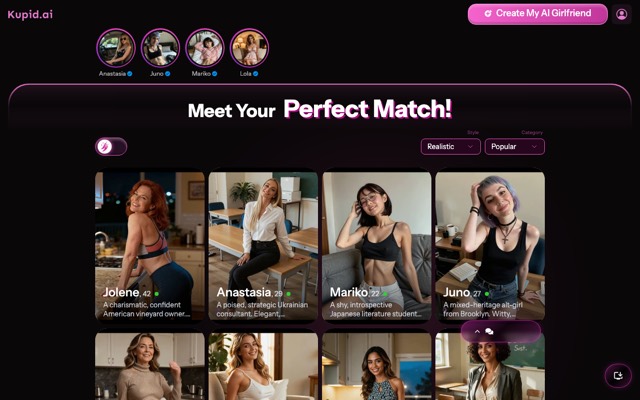
At the other end, Kupid AI gives you fifteen messages. Not fifteen a day. Fifteen.
After that the wall is absolute: no photos, no video, no voice, and a memory reaching back thirty messages you’ll never get to send. That isn’t a free tier in the sense Character.AI means it. It’s a demo with a countdown.
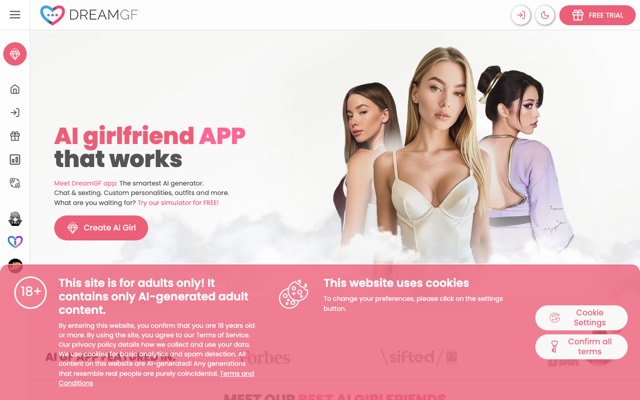
DreamGF publishes no free tier at all on its pricing page, though a “free trial” button sits in the site header with no terms attached to it.
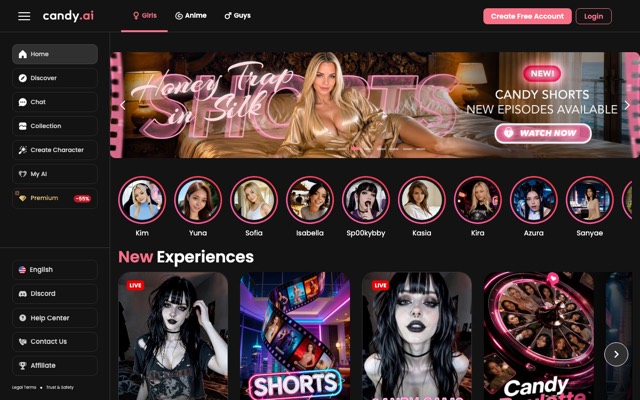
Then the honest blanks. Candy AI has a free account, and the signup button is right there, but publishes no limits for it anywhere we could find. Nomi says it’s free to start with no credit card required and stops there. SpicyChat and GirlfriendGPT publish nothing at all.
So when a list tells you the best free AI companion app, ask which definition of free it’s using. Unlimited-but-degraded and fifteen-messages-then-a-wall both count as “has a free tier,” and they’re nowhere near the same purchase decision.
Why the cheapest sticker is rarely the cheapest product
Sort the table by price and Candy AI’s annual plan lands near the bottom at $3.99 a month. It’s the lowest recurring number on this page. It also includes one hundred tokens a month.
Tokens are what break price comparison here. Several platforms charge a monthly fee that buys credits, then price individual actions in credits. An image costs some, a voice message costs some, a longer reply sometimes costs more than a short one. The subscription price is a floor, not a price. Two platforms at the same monthly fee can differ by a large multiple in what a normal month actually costs, depending entirely on how fast the credits burn, and nobody puts the burn rate on a pricing page.
It gets worse in a way that’s easy to miss. Because the burn rate isn’t the sticker price, it can be adjusted without any announcement. A platform can double what a typical month costs without ever “raising prices,” and no comparison table, including this one, would show a change. Where you see a token allowance above, read the monthly figure as a minimum and assume the real number is higher.
Compare that to Character.AI at $9.99 with unlimited messages, or Kindroid at $15.99 with unlimited messages on flagship models. Those are more expensive stickers attached to less elastic costs. Whether they’re more expensive products depends on how you use them, which is exactly the calculation the token model is built to obscure.
The stacking problem
Kindroid deserves a separate note, because its tiers don’t replace each other. They add. Standard is $15.99 a month. Ultra is a $24.99 add-on that requires Standard. MAX is a $59.99 add-on that requires both Standard and Ultra. Run the full stack and you’re at $100.97 a month, roughly ten times Character.AI’s ceiling, from a platform whose entry price is only six dollars higher.
Kindroid also charges more inside its apps than on the web: $28.99 against $24.99 for Ultra, $68.99 against $59.99 for MAX. That gap is the app store’s commission passed to the buyer, about sixteen percent. Subscribe from a phone without checking the website first and that’s what it costs you.
Memory is the central promise, and six of nine publish no number
Every product on this page sells the same thing in roughly the same words. It remembers you. It knows your history. It grows with you.
That’s the only promise here that genuinely matters, since nobody downloads a companion app for factual accuracy. It’s remarkable how few companies will attach a figure to it.
Two do. Kupid AI publishes a plain message count: the free tier recalls the last thirty messages, Pro the last hundred, Ultra without limit. Kindroid publishes context windows in characters, roughly 500,000 on Standard, 1.3 million on Ultra and 2.8 million on MAX, with separate short-term figures. Both are checkable claims. That makes both companies unusual.
Character.AI markets “better memory” as a paid feature without quantifying either the free or the paid amount. The remaining six publish nothing.
This is the gap we find most interesting, and the one we intend to close ourselves. A published context window is a claim you can test. The absence of one means the marketing copy about remembering your life isn’t attached to anything a customer could ever verify. We’re building a memory benchmark to test the claim directly on every platform here, and the two companies above will serve as controls, because they’re the only ones who’ve told us what to expect.
What the privacy policies actually commit to
The right-hand columns come from reading all nine privacy policies line by line. One caution about how to read them, because it separates an accurate table from a misleading one.
“Not stated” is not “no.” When a policy doesn’t address whether the company trains its models on your conversations, we record that it doesn’t address it. We don’t record a no, and we’d ask you not to read one. A company that has never written down what it does with your chat logs has told you less than one that admits it trains on them, not more.
With that in mind, here’s what the documents say.
Two of nine state outright that they train on user content. Candy AI and Character.AI. Candy AI goes considerably further than anyone else, and its policy is worth quoting because it’s the only place here where a customer can find this out: moderation and AI-service providers, “including at our discretion third-party LLM providers and/or hosters,” may “receive the content of your messages exchanged with our chatbot.” It also confirms human review of flagged content and of de-identified interactions during dataset preparation.
Being the most candid document in the set doesn’t mean having the best practices. It may only mean the others haven’t written theirs down. But Candy AI is currently the only platform here where you can answer “does anyone outside this company read what I typed?” from published material.
One of nine promises to tell you about a breach. GirlfriendGPT’s policy commits to notifying users and regulators “where we are legally required to do so.” That qualifier is doing a lot of work, and it’s still the strongest commitment in the set. The other eight say nothing about breach notification at all. In a niche whose reference incident, the Muah.ai breach, involved exactly the kind of material people assume is private, that silence is worth weighing.
One of nine gives a deletion window in days. Nomi states that deleting your account removes personal information within about twenty-eight days. It’s the clearest deletion promise here, and it arrives with a carve-out that deserves reading twice. The clause begins “Except for information that is in our training or communications archives.” Training isn’t mentioned anywhere else in Nomi’s policy. So the document won’t tell you whether your conversations are used for training, but it will tell you that if they are, deleting your account doesn’t reach them.
Elsewhere, Kupid AI and GirlfriendGPT both state that they retain personal information for six years after an account is closed. Kindroid holds chat conversations and generated media until you delete the AI or the account, with no automatic expiry. SpicyChat and DreamGF fall back on “as long as is necessary” with no window attached.
Two competitors, one privacy policy
The strangest thing we found isn’t in a single policy. It’s between two of them. Kupid AI and GirlfriendGPT publish the same privacy policy. Not a similar one. The same sentences.
Both contain, word for word, the same no-sale clause. Both contain, word for word, the same line about a moderation team checking compliance via cookies and server logs. Both state the same six-year retention period in the same phrasing. Kupid’s copy still names an entity called “Usway” in its marketing-consent section.
We verified this by string match against both live documents on the same day. At minimum it means neither document was written about the product it governs. The six-year retention figure in particular reads like a legal-template default, not a considered decision about what to do with intimate chat logs, which is what it’s actually governing.
The policy that predates the product
SpicyChat’s privacy policy was last updated on 4 May 2023. In the entire document, the word “message” appears zero times and the word “conversation” appears zero times.
This is a platform whose product is conversation. Its privacy policy doesn’t discuss conversations. It’s silent on training, silent on human review, silent on data sharing, silent on breach notification, and offers “as long as is necessary” on retention. It hasn’t been revised in over three years, while the product and everything around it changed substantially.
How to read a discount here
Almost every platform on this page runs a permanent sale. A few deserve specific mention, because you can check the mechanics from a browser.
Kupid AI displayed an “Easter Discount — 75% OFF” banner on 31 July, attached to a live countdown timer. On first load the timer read 33:22:00. We navigated away and came back. It read 33:22:00 again, to the centisecond. It resets on every page load. It isn’t counting toward anything, and Easter was in April.
Kupid’s tiers also don’t run in the direction you’d assume. Its Ultra plan, at $299 a year, includes thirty-five minutes of voice per week. Its Lifetime plan, at $777 once, includes thirty-five minutes of voice per month. The more expensive option gives roughly a quarter of the allowance. Both numbers sit on the same feature table.
DreamGF’s pricing page mislabels its own plans. As published: the plan called “3-Month Membership” recurs at $25.99 per month, and the plan called “Monthly Membership” recurs at $77.97 every three months. The introductory payment and the renewal payment differ by between two and four and a half times depending which you choose. We’ve quoted it exactly as published instead of silently correcting it, because a pricing page that contradicts itself is a fact about the product.
Candy AI’s 70% discount has no stated expiry, which we record as the real price rather than a promotion, because that’s what a permanent discount is.
The general rule: a countdown that survives a page reload is decoration, and an introductory price only means something next to the renewal price. Here, the second number is usually the hard one to find.
What we still owe this page
Three things, stated plainly, because a table like this is worth exactly what its method is worth.
These are pricing-page prices, not checkout prices. The two disagree more often than they should, and closing that gap means paying for each platform and reading the number at the point of sale. That work is planned and not done.
Replika’s row is incomplete. Its legal pages were unreachable on the day of the audit and no archived snapshot of that URL exists, so its privacy columns are blank. Not because Replika publishes nothing, but because we couldn’t read it. That row is open, and we’d rather say so than fill it from memory or a third-party summary.
The free-tier cells reading “limits not published” need accounts to resolve. Only Kupid publishes its wall. Establishing where the others actually cut you off means creating an account on each platform and using it until it stops, which is separate work we’re doing rather than estimating.
We update this page in place instead of publishing a new version at a new address, so the date under the table is always the date the numbers were last verified.
FAQ
Which AI companion app is genuinely free?
Character.AI offers unlimited messaging on its basic models at no cost, with advertising and a slow mode during busy periods, and it’s the closest thing here to a product you can use indefinitely without paying. Kindroid also offers unlimited free messages, but on a smaller distilled model called Lite, with two selfie requests per two hours and roughly five minutes of audio for the lifetime of the account. Kupid AI, by contrast, gives fifteen messages in total before a hard wall. Four platforms (Candy AI, Nomi, SpicyChat and GirlfriendGPT) don’t publish their free-tier limits at all.
Why do some AI girlfriend apps not show their prices?
Four of the nine platforms we track don’t display a price to a logged-out visitor: SpicyChat, Nomi, Replika and GirlfriendGPT. SpicyChat’s pricing page returns a 404 and its upgrade flow requires an account. Nomi has no pricing page. GirlfriendGPT’s pricing page loads without prices on it. Replika’s own help centre states that costs appear only inside the app and the relevant app store. In each case you have to create an account or install an app before the number becomes visible.
Do AI companion apps train their AI on my conversations?
Two of the nine say so explicitly in their privacy policies: Candy AI and Character.AI. Candy AI additionally discloses that third-party language-model providers and hosting partners may receive the content of your messages. The remaining seven don’t address the question in their published policies, which isn’t the same as denying it. A policy that’s silent on training has told you nothing either way.
Which AI companion app has the best memory?
Only two publish a figure you can check. Kindroid states context windows of roughly 500,000 characters on its Standard tier, 1.3 million on Ultra and 2.8 million on MAX. Kupid AI states that its free tier recalls the last thirty messages, Pro the last hundred, and Ultra without limit. Character.AI markets better memory as a paid feature but doesn’t quantify it. The other six publish no memory figure at all, so their claims about remembering you can’t currently be verified by a customer.
What happens to my chats if I delete my account?
It depends heavily on the platform, and most won’t tell you. Nomi gives the clearest answer, deleting personal information within roughly twenty-eight days, but exempts anything already held in its training or communications archives. Kupid AI and GirlfriendGPT both state they retain personal information for six years after an account closes. Kindroid holds your conversations and generated media until you delete the AI or the account. Candy AI says it deletes without undue delay on request, while retaining financial records for ten years. SpicyChat and DreamGF state only that data is kept as long as necessary, with no window.
Will these apps tell me if they get hacked?
One of the nine commits to it in writing. GirlfriendGPT’s policy says it will notify users and any applicable regulator of a breach where legally required to do so. The other eight policies contain no breach-notification clause at all. Given the sensitivity of what these services store, we treat this as one of the more significant gaps on the page.
Is the discount on these sites real?
Sometimes, and you can often check the mechanics yourself. Kupid AI ran an “Easter Discount” banner in July alongside a countdown timer that resets to the same value on every page reload. Candy AI’s 70% annual discount carries no expiry date, which makes it the ordinary price rather than a promotion. DreamGF’s introductory payments and renewal prices differ by between two and four and a half times. The reliable test is to reload the page and see whether the urgency survives, then look for the renewal price rather than the first payment.
How often is this comparison updated?
The date beneath the table is the date every cell was last verified against the platforms’ own pages. We update this page in place instead of publishing a new version at a new address, so links to it stay pointed at current data.